Classroom Lessons
The teacher is explaining. But students are not necessarily taking in every word. The lesson moves on even when something is missed, and the explanation disappears as it is spoken.
The CREATE BASE system, in your home.
Beyond solutions. Discover how exceptional minds decide.
CREATE BASE does not compete on the same terms as tutoring, schools or textbooks.
It sits beneath them, defining the standard for learning itself.
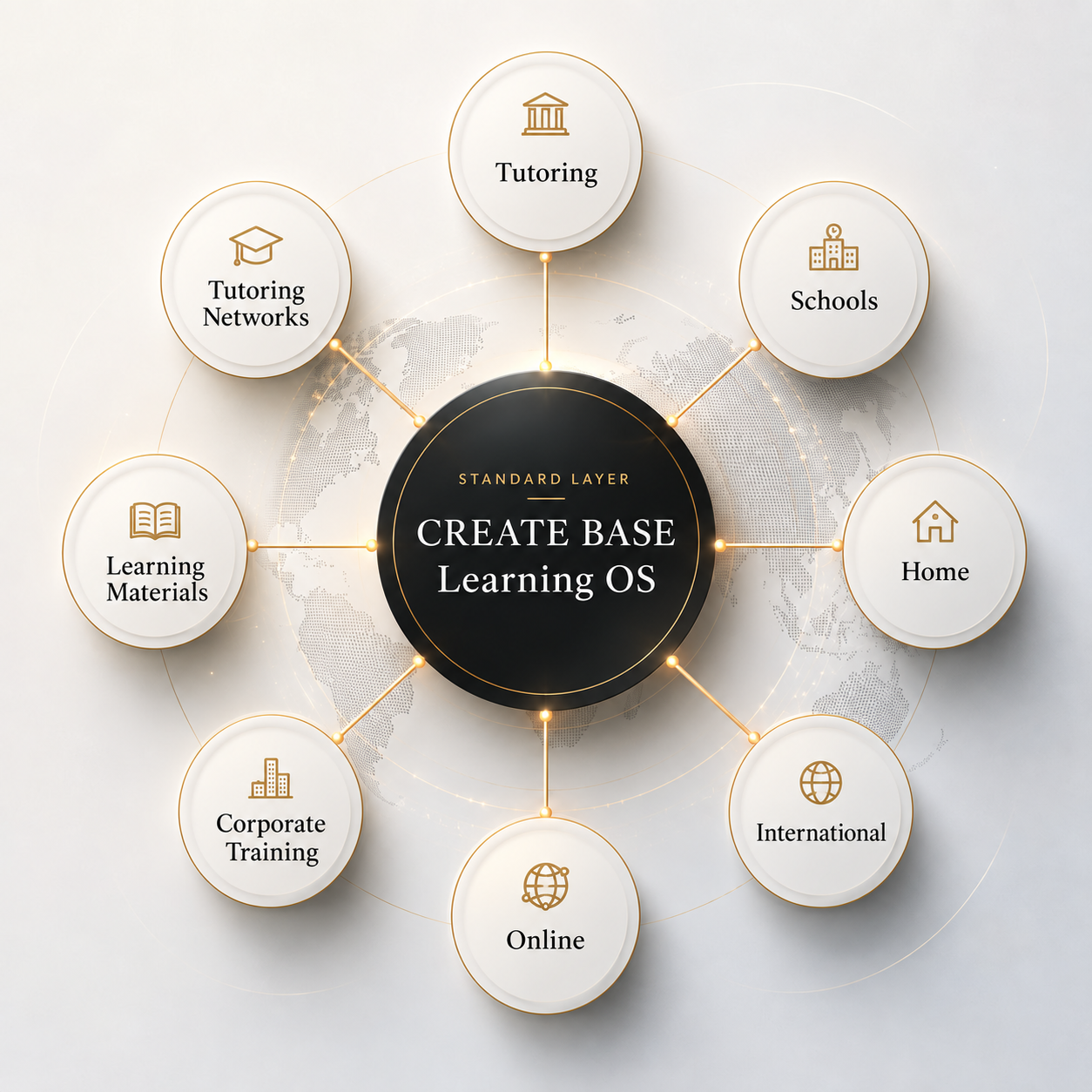
Tutoring, schools, tutoring networks, learning materials, corporate training, online learning, international settings and the home.
The standard reaches learners through all of these channels.
Individual implementations may change. The underlying standard endures.
Families spend tens of thousands of yen a month on tutoring. Still, the goal remains out of reach.
The problem is neither the amount spent nor a lack of effort.
The root cause is the structure of today’s education systems.
Teaching through people tends, by design, to teach too much. Good intentions and the terms of the service take away the time children need to think.
The teacher is explaining. But students are not necessarily taking in every word. The lesson moves on even when something is missed, and the explanation disappears as it is spoken.
Say “I don’t understand,” and an explanation arrives immediately. That is the structural flaw. Each time a child’s thinking stops, someone else’s judgment steps in. Children learn that stopping brings help. What grows is dependence on instruction, rather than the ability to solve problems.
The adult sitting beside a child struggles to tolerate silence. Time spent thinking looks like time without progress. When a service is paid for by the hour, quiet waiting is hard to value. Even with the best intentions, too much teaching follows.
Send “I don’t understand,” and an answer comes back. Messaging, chat support and AI question services may look different, but their structure is the same. As soon as thinking stops, everything is filled in. Convenience removes the space to think.
Materials, by their structure, tend to leave learners on their own. The next step they need is missing at the exact point where they get stuck.
You can pause and replay, but the basic structure is still a lesson. The presenter determines the sequence, while the learner receives information flowing from a screen.
At their best, books let learners read, think and revisit at their own pace. Yet increasingly, sales appeal and the promise of “easy understanding” take priority, filling even the spaces where thinking should happen.
The finished equations and answers are there. But what to notice, how to organize the information and why to move to the next equation are not separated into individual steps.
The problems are collected and the answers supplied. But how to look at this particular problem, and why to choose a particular procedure, are nowhere on the page. The compiler’s judgment never reaches the learner.
More fundamentally, the industry itself is not designed to develop judgment. Tutoring centers and schools are evaluated through admissions results and standardized rankings. Whether a child has learned to make independent decisions appears in none of those measures. Neither providers nor learners have an economic incentive to develop that missing step. That is why the industry has not built it. Families have been left to fill the gap themselves.
The harm then flows into the home. The anxiety and rankings sold by the tutoring industry—“Finish by this date or you’ll fall behind,” “That child has already finished”—are amplified through social media and parent communities. Well-intentioned parents respond by imposing more time, more work and more pressure. This is where educational abuse can begin. Families are not the source of that pressure. The information reaching them is.
There is another change: explaining how to solve a problem no longer commands a fee in itself. Much of tutoring and educational publishing has charged for teaching methods of solution. Now AI can provide such explanations freely and without limit. The value that remains is making an expert’s decision-making process reproducible at home.
No over-teaching. No abandonment. No industry constraints or pressure on families.
We break decision-making into its smallest steps and deliver them directly to the home, from outside the industry’s framework. This is our slide-based approach: a system that has consistently pursued what remains valuable in the AI era—making reasoning reproducible.
This goes beyond entrance exams. It develops the thinking processes used to solve problems of every kind.
The quickest way to understand why this system works is to see what happens inside CREATE BASE.
The moment we see a problem, we know what to look at, how to organize it and which approach to take. It emerges rather than requiring deliberate thought. The labor comes afterward: performing the calculations and turning an instant of judgment into an explanation someone else can follow.
Simply “teaching a solution” misses the point. A classroom explanation fades. An equation in a reference book can be copied, yet fails to come to mind on the next problem. What learners acquire is not a solution, but judgment itself.
We have practiced this in our classroom for years. Our students’ admission to Nada Junior High School demonstrates that the approach can deliver.
The world finally recognized that explaining a solution no longer has paid value in itself. CREATE BASE understood this before AI and was already putting that understanding into practice.
Ideally, someone who possesses that judgment would teach it directly. But one person can reach only so many children. We use AI to make it available more broadly, bringing a version with consistent quality at an affordable cost into the home. That is our slide-based approach.
We believe this will become the next generation of learning infrastructure, built on the highest levels of human reasoning. Making decision-making reproducible is the learning value that endures in the AI era. We have pursued it early and consistently. That is why we believe this system can go as far as learning itself.
CREATE BASE develops and operates its own learning systems.
Our databases of problems, explanations and curricula form a shared foundation.
We build the tools our learners need—from practice systems and learning-data management to educational consultation and adaptive flashcards. When existing tools cannot solve a problem, we develop a new one.
This brings educational experience, AI analysis and automation into the same development process, so the system can evolve alongside the needs we encounter in practice.
These are not explanations improvised by an AI on the spot.
They are built on accumulated, structured judgment.
We collect problem classifications, points of focus, ways to organize conditions, method selection, operation sequences, chains of equations and verification methods.
We turn this knowledge into a sequence of decisions learners can follow one step at a time, rather than a finished answer to memorize.
We deliver slides that learners can pause, revisit, compare and repeat.
In our classroom practice system, learning data helps shape an individual curriculum.
Instructors step in when support is needed.
Accuracy data helps us see what a learner has mastered and what needs further practice.
We examine points of difficulty to understand where support is needed in the learning process.
Progress data informs the curriculum, helping each learner work at a pace suited to them.
The system supports day-to-day practice. Instructors provide help at the points where a learner needs it.
Structured explanations and solutions for Japanese junior high school entrance-exam problems, designed for learning at home.
A school in Umeda, Osaka, preparing students for demanding junior high school entrance exams through independent practice and individualized curricula.
Custom educational systems designed and built for schools, tutoring providers, businesses and individuals.
Children described as exceptionally gifted are developing through this approach.
One year, a student returned from an entrance exam and said:
“I didn’t do anything special. I just read the questions as they were written and followed them to the answers. It was simply a matter of doing the work.”
This was neither boasting nor bravado. It was a report that not a single new decision had been needed in the exam room. What to notice. What to draw. Which method to choose and how to connect the steps. Those decisions had already been made through everyday practice. All that remained on exam day was to carry out the usual procedures with the usual precision. The student called it “simply a matter of doing the work.”
This is the state we aim to create by bringing the reasoning process into the home.